
Fazal Dayan
I am a computational chemist specializing in the theoretical design and electronic structure analysis of nanomaterials for energy storage applications. I am currently based in Islamabad, pursuing further doctoral studies in computational materials chemistry, with active research affiliations at Quaid-i-Azam University.
My work centers on applying first-principles quantum chemical methods to the rational design of cathode and anode materials, with particular emphasis on multi-ion battery systems (Li+/Na+/K+) and their underlying electronic behavior.
2
Research
8
Publications
Global
Collaborations
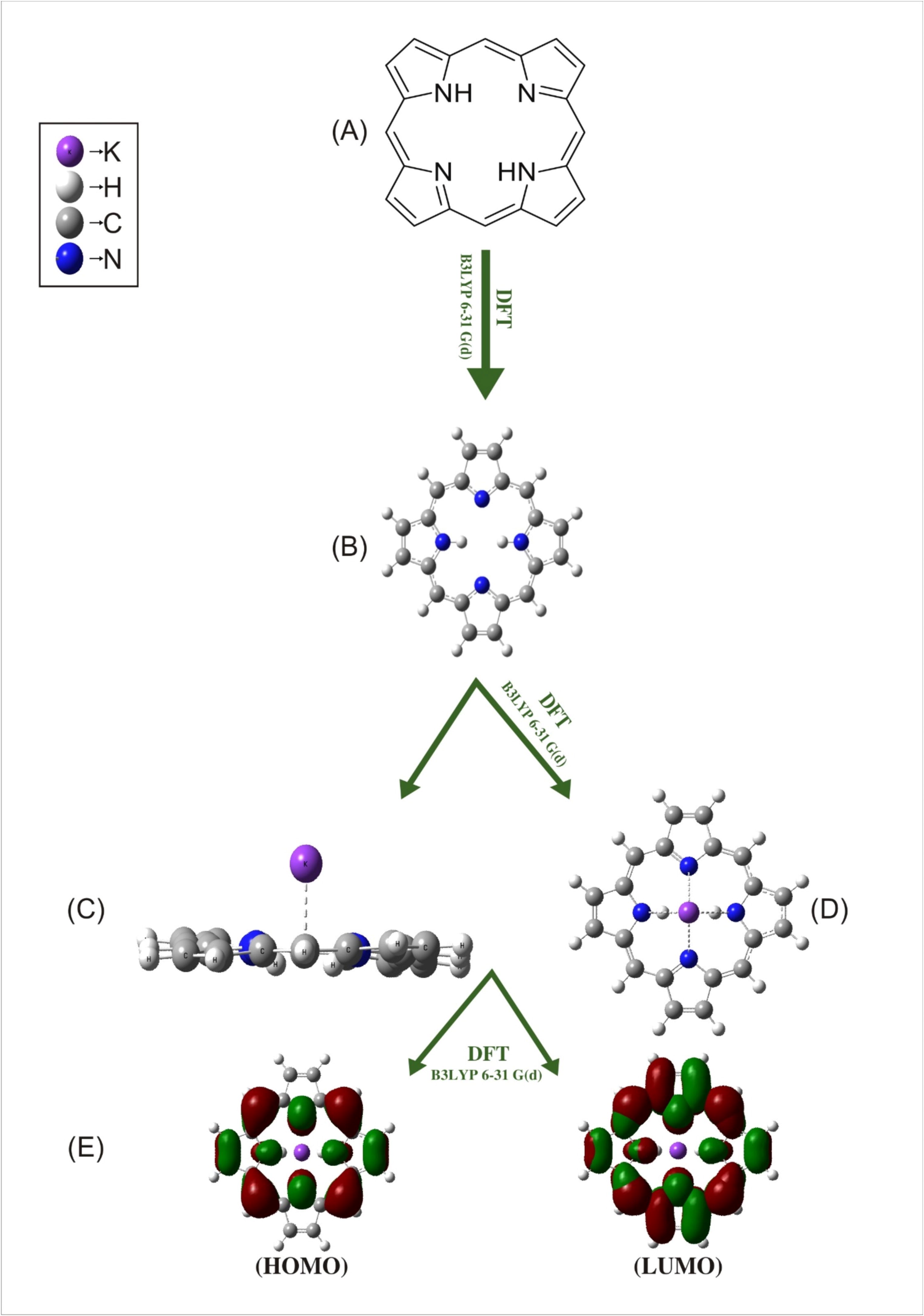
Designing and investigating electronic states of porphyrin Schiff bases nanoflakes, cathode materials for K+ - batteries
1

News and Events
Stay updated with our latest research advances, scientific publications, conference presentations, workshops, laboratory activities, research milestones, and academic announcements.
Porphyrin-based materials have become attractive options because of their generous surface area and advantageous photo-physical characteristics. As effective cathodic materials for KIBs, porphyrin Schiff base nanostructures (SBNs) are suggested in this wo
These findings are expected to provide a valuable theoretical framework for future researchers to experimentally employ these compounds. Ultimately, these results offer promising pathways towards the development of cost-effective, sustainable, and renewable Potassium ion batteries.
Welcome New Researchers to the Lab
We are thrilled to welcome researchers to help drive our upcoming projects.
Our Latest Research Published in the Journal of Molecular Structure
Our research team is pleased to announce the publication of a new research article in the Journal of Molecular Structure: "Biological Assessment of New Biocompatible Zinc(II) Dithiocarbonates: Experimental and Computational Approaches" Journal of Molecular Structure (2026), 146813. https://doi.org/10.1016/j.molstruc.2026.146813
Research Expertise
I have hands-on experience with Density Functional Theory (DFT) calculations for electronic density, electronic states, band gaps, and HOMO–LUMO analysis
I work with electronic structure and band analysis, including Density of States (DOS) and Projected Density of States (PDOS) evaluation.I design materials for lithium-, sodium-, and potassium-ion battery cathodes and anodes
I conduct adsorption studies for catalytic processes and charge-storage capability prediction. I am skilled in basis set selection and optimization for accurate computational modeling
I am proficient in Gaussian, GaussView, Avogadro, and Materials Studio (DMol³, CASTEP)
I have experimental electrochemical experience, including cyclic voltammetry, gained through hands-on research on CO2 reduction during an internship at Quaid-i-Azam University
Featured Research
Explore our ongoing research in computational chemistry, energy storage materials, and advanced functional materials
Modeling and Investigating COF-Based Electrode Materials for Sodium-Ion Batteries
As global demand for energy storage grows, sodium-ion batteries (SIBs) have emerged as a promising, cost-effective, and resource-abundant alternative to lithium-ion systems. However, the larger ionic radius of Na? compared to Li? imposes distinct structural and mechanistic challenges for electrode design many materials optimized for Li? storage perform poorly with Na? due to sluggish diffusion kinetics and structural degradation. This project investigates Covalent Organic Frameworks as electrode materials specifically engineered to accommodate Na? ion storage.
Computational Designing of COFs-based Cathode Materials for Lithium-Ion Batteries
This project focuses on the rational, computation-driven design of Covalent Organic Framework (COF) materials as next-generation cathode materials for lithium-ion batteries (LIBs). Conventional cathode materials, such as layered transition-metal oxides, face limitations in capacity, cycling stability, and reliance on scarce or costly elements. COFs crystalline, porous, organic polymers built from light elements (C, H, N, O) linked by strong covalent bonds offer a tunable, metal-free (or low-metal) alternative with structurally programmable redox-active sites, high surface area, and well-defined pore channels suited for fast ion transport.